

26 May
Stainless Steel Flatware Texture Depth for OEM and Private Label Manufacturing
Stainless Steel Flatware Texture Depth f...
Stainless Steel Flatware Texture Depth for OEM and Private Label Manufacturing
Decorative texture is one of the details that can give stainless steel flatware a distinctive appearance. Fine lines, embossed patterns and recessed details can change how light moves across a spoon, fork or knife and help a private label collection develop its own visual identity.
For B2B buyers, however, texture is not only a design decision. The depth of a decorative feature can affect its appearance after polishing, the clarity of the pattern and the consistency of mass production.
Homefelt factory supports stainless steel cutlery projects where decorative details need to be translated from a design concept into repeatable manufacturing specifications.
Why Texture Depth Matters in Stainless Steel Flatware
A decorative pattern may look simple on a computer drawing, but the finished effect depends on several factors.
Texture depth can influence:
Pattern visibility
Light reflection
Contrast between raised and recessed areas
Surface feel
Cleaning characteristics
Forming requirements
Polishing results
Batch-to-batch appearance
A texture that is too shallow may become difficult to see after finishing. A feature that is too deep may change the visual balance of the handle or make production more complicated.
The right specification therefore depends on the overall design rather than on depth alone.
Common Types of Flatware Texture
Different stainless steel cutlery collections may use different decorative approaches.
Linear textures can create a modern appearance and are often suitable for minimalist handles.
Hammered or irregular textures can produce a more handcrafted visual effect.
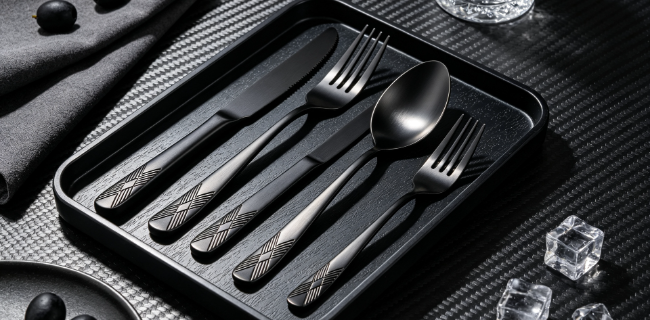
Geometric patterns can support a stronger private label identity, especially when repeated consistently across knife, fork and spoon handles.
Fine recessed lines can add visual detail without significantly changing the overall profile.
Raised decorative features can create stronger highlights and shadows, but they require careful coordination with forming and finishing.
Each style requires its own manufacturing evaluation.
Texture Depth and Material Thickness
The relationship between decorative depth and stainless steel thickness is important.
The available material thickness limits how aggressively a surface can be formed without affecting the surrounding structure. A decorative feature should therefore be developed with the material specification in mind.
For example, a relatively thin flatware handle may require a different texture approach from a thicker handle with a more substantial profile.
During OEM development, Homefelt can review the proposed texture together with:
Stainless steel grade
Material thickness
Handle width
Handle profile
Texture depth
Pattern spacing
Pattern direction
Surface finish
Product dimensions
Production quantity
This helps the buyer understand how the design may translate into a finished stainless steel product.
Keeping the Texture Visible After Finishing
One common challenge with textured flatware is maintaining the intended appearance after polishing or surface treatment.
Stainless steel reflects light strongly. A pattern that is clearly visible on an unfinished sample may appear different after polishing.
The final visual effect depends on the relationship between texture geometry and surface treatment.
For polished products, highlights can make raised areas appear stronger while recessed areas create darker visual lines.
For satin or brushed finishes, the direction of the surface treatment can change how clearly the pattern is seen.
For colored stainless steel cutlery, texture can also affect how the coating visually follows the surface.
This is why texture should be evaluated on a finished sample rather than approved only from a digital rendering.
Texture Consistency in Mass Production
For a B2B buyer ordering several thousand pieces, consistency becomes particularly important.
If the texture depth varies from one production batch to another, the same SKU may appear different when displayed together. This can be a problem for retail brands, distributors and hospitality customers that expect a consistent collection.
Production control can therefore focus on defined reference points rather than relying only on visual judgment.
Depending on the design, inspection may consider:
Texture position
Pattern dimensions
Pattern spacing
Feature depth
Surface condition
Handle profile
Overall appearance
The inspection method can be adapted to the product and the buyer's quality requirements.
A Practical OEM Development Example
Imagine a private label brand developing a new flatware collection with a fine geometric pattern on the handle.
The initial artwork shows a repeating decorative motif. The buyer wants the pattern to remain visible but does not want it to make the handle look excessively heavy.
During development, the design can be reviewed against the proposed stainless steel thickness and manufacturing method.
A physical sample can then be produced and finished using the intended surface treatment.
The customer can evaluate the actual appearance under normal lighting before approving the final specification.
This process gives the buyer a more realistic reference than approving the artwork alone.
Designing One Texture Across a Complete Collection
When a buyer develops a knife, fork and spoon collection, the same decorative concept often needs to appear across all three products.
However, the available surface area is different on each item.
A spoon may have a wider handle than a fork. A table knife may have a different handle profile. If the same pattern is simply copied without adjustment, the visual proportions may not remain consistent.
A better approach is to define the design language first and then adapt the pattern to each product.
For example:
Keep the same general motif
Maintain consistent visual density
Align the pattern position across products
Adjust pattern scale when necessary
Preserve sufficient surface area around the design
Confirm the final effect through physical samples
This allows the collection to look coordinated without forcing identical geometry onto different products.
Texture and Private Label Product Identity
For private label buyers, decorative texture can be a useful way to distinguish a collection from standard flatware.
A relatively small modification to the handle surface may create a recognizable product characteristic.
However, the design should remain practical for production. A complicated texture with extremely fine details may require additional development work and tighter manufacturing control.
Homefelt can discuss these considerations during OEM or ODM development so the final design balances brand identity with realistic production requirements.
Tooling Considerations
When decorative textures are formed into stainless steel, tooling quality becomes important.
The tooling needs to reproduce the intended pattern accurately and repeatedly. Small changes in tooling condition can influence the final appearance of fine details.
For a new design, the factory can review the texture pattern before tooling development.
Important questions may include:
Is the pattern suitable for the selected material?
Is the required depth practical?
Is the spacing sufficient for consistent forming?
Will polishing preserve the pattern?
Does the texture interfere with other handle details?
Can the design be reproduced reliably at the planned volume?
Addressing these questions early can reduce unnecessary modifications later in the project.
Surface Finish Options
Texture and finish should be selected together.
A high-polish finish can emphasize the contrast between raised and recessed areas.
A satin finish can create a softer appearance and reduce strong reflections.
A brushed finish can introduce a directional visual effect, which may either complement or compete with the decorative pattern.
For colored flatware, finishes such as gold, black or other decorative tones can create a different visual relationship with the texture.
The best combination depends on the customer's product positioning and target market.
Homefelt Manufacturing Experience
Homefelt factory has 40 years of experience in stainless steel cutlery manufacturing and supports OEM, ODM, private label, wholesale and bulk production programs.
The factory can work with customer drawings, samples, reference products or new design concepts.
For decorative flatware projects, the development process can include product specification review, sample development, production planning, finishing coordination and packaging.
This experience allows design decisions to be considered from both the product and manufacturing perspectives.
Quality and Certification Support
B2B buyers may request inspection information and relevant certification documents during supplier evaluation or product development.
Homefelt has passed BSCI, SEDEX 4P, BRC and ISO9001 requirements and has experience with Disney audits. FAMA and FSC certifications are also part of its documented capabilities.
The exact documentation can be selected according to the customer's project requirements and target market.
For a custom flatware program, documentation works best when combined with clear product specifications and an approved physical sample.
OEM, ODM and Private Label Production
Homefelt supports customers who need:
Custom stainless steel flatware
OEM knife, fork and spoon production
ODM collection development
Private label manufacturing
Wholesale flatware supply
Commercial cutlery programs
Large-volume production
Custom packaging and branding
The factory can provide a one-stop service covering product design, manufacturing, packaging and transportation.
This allows customers to develop a complete project through one coordinated supply chain instead of managing separate suppliers for product production and packaging.
What Buyers Should Provide for a Texture Project
When requesting a quotation for textured stainless steel flatware, buyers can provide:
Product drawing or reference sample
Texture artwork or pattern
Target texture appearance
Material specification
Thickness requirement
Surface finish
Product quantity
Packaging requirements
Target market
Required delivery schedule
If the exact texture depth has not yet been determined, the buyer can provide the desired visual effect instead. The factory can then evaluate possible manufacturing solutions.
From Decorative Concept to Finished Flatware
A successful textured flatware project requires more than transferring a pattern onto stainless steel.
The texture must work with the product's material, geometry, forming process and surface finish. It also needs to remain consistent when the design moves from sample production to a large manufacturing order.
For private label brands, distributors and commercial buyers, this production consistency helps protect the appearance of the collection across future replenishment orders.
Homefelt aims to support customers through the complete process, from initial product concept to repeat bulk supply.
Discuss Your Custom Flatware Project with Homefelt
If you are developing stainless steel spoons, forks, knives or a complete flatware collection with a distinctive surface texture, Homefelt factory can review your design and manufacturing requirements.
Whether you already have technical drawings or only have a visual concept, the product can be developed around your material, finish, quantity and target market.
Homefelt provides OEM, ODM, private label, wholesale and bulk stainless steel cutlery manufacturing, together with product design, packaging and transportation support.
For samples, technical discussions or quotations, contact ingrid@homefelt.net.
You May Be Interested In
Homefelt factory provides customized stainless steel knife, fork and spoon production for brands, distributors and commercial buyers looking for reliable OEM and private label supply.
Send your texture artwork, product drawing or reference sample to discuss your next stainless steel flatware project and receive a production solution based on your requirements.