

27 May
Stainless Steel Cutlery Collection Planning for Retail and Wholesale Buyers
Stainless Steel Cutlery Collection Plann...
Stainless Steel Cutlery Collection Planning for Retail and Wholesale Buyers
A successful stainless steel cutlery collection needs more than a selection of individual spoons, forks, and knives. Each item should work with the others in appearance, dimensions, intended use, and packaging. For importers, retailers, and distributors, thoughtful collection planning helps create a consistent product range that can serve different customer needs without unnecessary duplication.
For B2B buyers, the challenge is balancing design consistency with commercial flexibility. A collection may need everyday dining pieces, additional serving utensils, or several set configurations for different sales channels. Homefelt factory supports stainless steel cutlery customization, OEM and ODM projects, private label development, wholesale supply, and bulk production to meet different product range requirements.
Define the Purpose of the Collection
Before selecting individual products, buyers should identify the intended market and use of the collection. A range designed for household retail may prioritize coordinated appearance and gift-ready packaging, while a hospitality-oriented range may focus on practical specifications, replenishment, and consistent availability.
The target customer influences decisions about product shape, handle design, finish, set composition, and price positioning. A premium retail collection may require distinctive decorative details, while a straightforward commercial range may favor a clean design that is easy to reorder.
Buyers should also decide whether the collection will contain one core design or several related designs. Establishing this direction early helps prevent a product range from becoming visually inconsistent as new items are added.
A useful starting document includes the target market, expected sales channel, key product types, approximate order quantities, and the intended price segment.
Create a Consistent Design Language
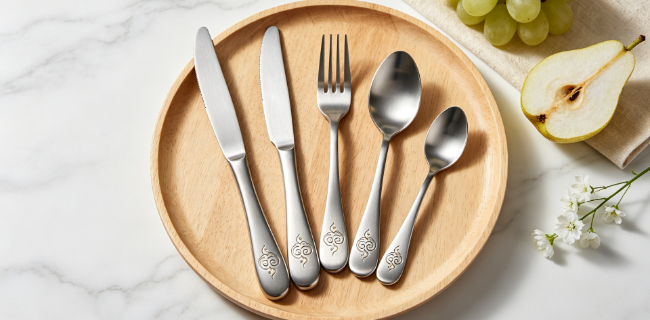
A coordinated cutlery collection usually shares recognizable design features. These may include handle proportions, edge profiles, surface finish, decorative elements, and the overall visual balance between the spoon, fork, and knife.
Consistency does not require every item to have identical dimensions. A teaspoon naturally differs from a dinner spoon, and a table knife has a different functional shape from a fork. The goal is to retain a common design direction while allowing each item to perform its intended role.
When reviewing potential products, buyers can compare:
Handle shape and width across the collection.
Surface finish and reflective appearance.
Decorative patterns or edge details.
Proportions between the handle and functional head.
Visual compatibility when pieces are placed together.
Reference photographs can help communicate the desired appearance, but technical drawings or approved samples are more suitable for confirming product dimensions and construction.
For custom projects, it is helpful to identify which design elements are fixed and which can be adjusted. This gives the factory a clearer basis for developing additional pieces within the same collection.
Select the Core Product Range
A collection should contain enough products to meet customer needs without making purchasing and inventory management unnecessarily complicated.
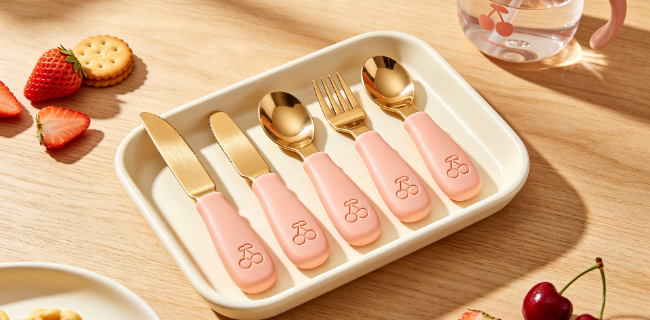
A basic dining range may include dinner spoons, dinner forks, table knives, and teaspoons. Depending on the target market, buyers may add dessert forks, soup spoons, or serving pieces as a separate extension.
The right assortment depends on the intended use and sales format. A boxed retail set may need a fixed number of pieces, whereas a distributor serving hotels or restaurants may prefer individual items purchased in larger quantities.
For each item, buyers should define the model reference, dimensions, material grade, finish, and estimated demand. This makes it easier to calculate the overall quantity required and compare product options.
When introducing a new range, consider starting with a clearly defined core collection. Additional items can then be developed after demand, customer feedback, and purchasing patterns become clearer.
Match Material, Finish, and Product Specifications
Product specifications should remain consistent across related items wherever the design permits. Material grade, thickness, weight, dimensions, and finishing requirements should be recorded separately for each model.
For example, a collection may use 304 or 430 stainless steel depending on the intended application and agreed specification. Buyers should confirm the selected grade for every relevant product rather than assuming that all pieces in a visually coordinated range use the same material.
Surface finish also requires attention. Mirror-polished and satin-finished items create different visual effects, and differences can become obvious when products are displayed together.
For a coordinated collection, buyers should agree on the finish reference and acceptable visual variation. Material certificates and relevant product testing documents can be reviewed according to the product specification and destination-market requirements.
The factory and buyer should also clarify how design changes will be controlled. A change in handle thickness, polishing method, or decorative detailing may affect how well a new item matches the existing range.
Plan Set Configurations for Different Sales Channels
One product collection can support several commercial formats. Retailers may want boxed sets in different piece counts, while wholesalers may purchase the same components as individual items.
Instead of creating unrelated product designs for every sales channel, buyers can consider using a common core range with different packaging and assortment options. This approach may simplify product management while giving customers more purchasing flexibility.
When planning each configuration, record the number of spoons, forks, knives, and additional pieces. Confirm whether all items use the same finish and whether any packaging insert is designed for a specific arrangement.
Buyers should also distinguish between the number of pieces and the number of place settings. These terms can describe different things, so the product listing and packaging should make the set contents clear.
A set configuration sheet helps prevent inconsistencies between quotations, product labels, packaging artwork, and shipment records.
Consider Packaging and Brand Presentation
Packaging should support the collection's intended position in the market. Individual sleeves, standard cartons, retail boxes, gift packaging, and customized inserts all create different presentation and cost considerations.
For retail collections, buyers should check whether the package accommodates each item securely and displays the brand clearly. For bulk hospitality orders, protective packaging and efficient carton arrangements may be more important.
Private label buyers should coordinate packaging artwork, logo placement, product descriptions, barcode information, and carton markings with the approved product specifications. Changes to set contents may require corresponding packaging revisions.
Homefelt factory can discuss product and packaging coordination as part of a broader project service, depending on the agreed scope. Confirming these details before mass production helps reduce avoidable rework.
Use Samples to Confirm Collection Compatibility
A sample review should cover both individual product quality and the appearance of the collection as a whole.
Check the dimensions, material specification, weight, surface finish, handle proportions, and visible workmanship of each item. Place the pieces together to assess whether the design language remains consistent across different sizes and functions.
For a retail set, also review the actual packaging arrangement. A product may look suitable on its own but require a different insert or layout to fit the planned box.
Once approved, retain the relevant samples, drawings, and specification records. If the collection is expanded later, these references can help guide the development of compatible products.
Inspection requirements should be agreed upon before bulk production. Depending on the project, records may include dimensional checks, appearance inspection, material documentation, and applicable testing reports.
Coordinate Collection Development with Homefelt Factory
Homefelt factory works with B2B customers seeking stainless steel knives, forks, spoons, and complete cutlery collections. Depending on project requirements, cooperation may include product selection, customized design, OEM or ODM development, private label branding, packaging coordination, and wholesale or bulk supply.
To begin a collection project, buyers should provide the intended market, preferred design references, required item list, material and finish specifications, estimated quantities, and packaging expectations.
If the collection needs to expand an existing product line, include samples, drawings, or specification sheets from the current range. This helps establish which characteristics should remain consistent and which can be adapted.
Relevant certifications and testing documentation can be discussed according to the actual products and applicable market requirements. Buyers should confirm the required records before production rather than assuming every product follows an identical documentation scope.
A well-planned collection creates a clearer product identity and a more manageable purchasing structure. By coordinating design, specifications, set composition, and packaging from the beginning, buyers can build a stainless steel cutlery range suited to their market and future replenishment needs.
You May Be Interested In
Explore stainless steel cutlery options for coordinated product collections.
Discuss OEM and ODM development for new spoon, fork, and knife designs.
Request private label packaging and customized set configurations.
Contact Homefelt factory for wholesale pricing and bulk production planning.
When requesting a quotation, share your planned product range, quantities by item, material requirements, finish preferences, and packaging format. The Homefelt team can review your requirements and discuss suitable options for developing a consistent cutlery collection.