

01 May
Stainless Steel Cutlery Logo Marking: Placement and Quality Control
Stainless Steel Cutlery Logo Marking: Pl...
Stainless Steel Cutlery Logo Marking: Placement and Quality Control
For retailers, distributors, promotional product companies, and private-label brands, a logo can turn a standard stainless steel cutlery set into a recognizable product. However, successful branding involves more than adding a company name to a spoon, fork, or knife. The marking method, position, size, contrast, and consistency all influence the finished appearance.
When sourcing custom cutlery in bulk, buyers should confirm branding details before production begins. Homefelt factory works with customers on stainless steel knife, fork, and spoon customization, helping coordinate product specifications, logo requirements, packaging, and other project details.
Choosing a Suitable Logo Marking Method
The best marking method depends on the cutlery design, surface finish, artwork, expected appearance, and budget. Buyers should evaluate the actual product rather than selecting a process based only on its name.
Laser marking uses a laser to create a controlled mark on the surface. Depending on the stainless steel grade, surface treatment, machine settings, and marking process, the result may appear dark, light, or as a subtle change in surface appearance. It is useful for logos that require controlled positioning and clear detail, subject to the limits of the chosen equipment and design.
Mechanical stamping or embossing creates a mark through pressure applied to the metal. It can produce a more tactile result, but the available detail depends on the artwork, metal thickness, tooling, and the geometry of the spoon handle, fork handle, or knife handle.
Other marking or decorative methods may be suitable for particular designs. Buyers should ask the factory which options are available for the intended product and whether the method is appropriate for the required finish and use conditions.
A practical starting point is to provide the original logo artwork, expected logo dimensions, preferred appearance, and estimated order quantity. The supplier can then assess feasibility and recommend a suitable approach.
Where Should a Logo Be Placed on Cutlery?
Logo placement affects both visibility and the overall design. A large mark may be easy to recognize but can make a slender handle look crowded. A very small logo may preserve a minimalist appearance but become difficult to read.
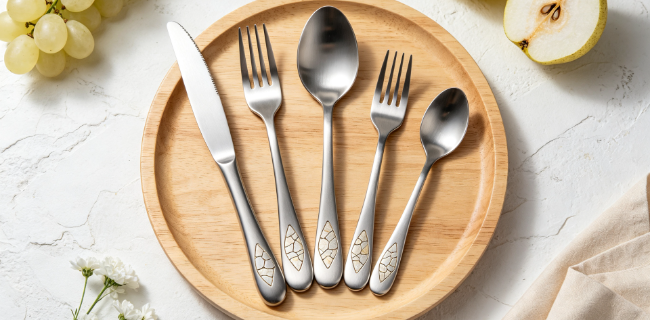
For a dinner spoon, the handle is often considered because it provides a relatively defined area for branding. The available space depends on the handle's width, curvature, pattern, and decorative details.
For a fork, the handle may offer a suitable marking area, although its shape and taper can limit the usable space. For a table knife, the handle design and construction should be reviewed before the marking position is confirmed.
Buyers should consider the following factors:
Usable marking area and handle geometry.
Distance from decorative patterns, edges, and transitions.
Logo size and readability at normal viewing distance.
Alignment across matching spoons, forks, and knives.
Compatibility with the selected surface finish.
Whether the logo remains visually balanced across different product sizes.
A simple placement drawing can prevent misunderstandings. It should identify the product, marking surface, logo dimensions, orientation, and approximate distance from a defined reference point. For projects involving multiple SKUs, each product should have its own approved placement reference where necessary.
Preparing Artwork for Accurate Marking
Artwork quality is an important part of logo customization. Low-resolution images taken from a website may not contain enough detail for accurate production. Small text, fine lines, intricate symbols, and narrow gaps can also become difficult to reproduce on a limited marking area.
Vector artwork is generally useful because it can be scaled without the same loss of clarity associated with enlarging a small raster image. Buyers should provide an approved logo file and confirm the intended proportions, lettering, and spacing.
Before mass production, review a marking sample or product proof. Check whether the logo is complete, correctly oriented, aligned with the handle, and consistent with the approved artwork. Pay particular attention to fine details and the appearance of the mark against the selected stainless steel finish.
If the logo is being adapted to fit a narrower handle, the factory should obtain approval for any proposed adjustment. Changing letter spacing, removing small elements, or simplifying a symbol without confirmation can create differences from the brand's original identity.
Evaluating Logo Quality During Inspection
A logo can look correct on one sample and still require attention when many pieces are produced. For bulk stainless steel cutlery orders, buyers should define acceptance criteria before manufacturing.
A logo inspection can include:
Position: the mark follows the approved reference location.
Orientation: text and symbols face the intended direction.
Dimensions: logo size remains within the agreed tolerance.
Completeness: no missing lines, incomplete characters, or unintended distortions.
Appearance: contrast and definition match the approved sample.
Surface condition: no unacceptable scratches, dents, or marking-related damage.
Consistency: matching products show a uniform branding style.
The exact inspection limits should be agreed according to the product and project. For example, a premium retail collection may require tighter visual consistency than a simple promotional order. Buyers can define acceptable variation through an approved sample, written criteria, and a documented inspection plan.
Where a logo method may be affected by abrasion, repeated washing, or contact with cleaning agents, the parties should discuss appropriate durability evaluation. Test conditions should reflect the intended use, and conclusions should be based on the actual method and evidence rather than general assumptions.
How Branding Connects With Material and Surface Finish
Stainless steel grade and surface finish can affect how a logo appears. A polished handle reflects light differently from a brushed or satin-finished surface. The same marking process may therefore produce different visual results across different finishes.
The handle's thickness, curvature, and construction also influence which areas can be marked reliably. Buyers should confirm the relevant product specifications before approving the final design.
For cutlery projects, a product specification may record the stainless steel grade, dimensions, thickness, weight, finish, logo method, marking position, and applicable inspection criteria. These details help the buyer and manufacturer work from the same requirements when developing samples and preparing repeat orders.
Material documentation and product testing should be reviewed according to the product and destination-market requirements. A factory's management-system or social-compliance certification should not be confused with proof of logo durability or automatic approval of every finished product.
A Practical Workflow for OEM and Private-Label Cutlery
A clear branding workflow reduces avoidable revisions during production.
First, provide the logo artwork, target products, estimated order quantity, and preferred marking appearance. Next, confirm the marking method and agree on the logo's dimensions and placement. Review a physical sample or an appropriate production proof before approving the final specification.
After approval, record the selected artwork version and product reference. If the logo, handle design, or finish changes later, confirm the revised details before the next order proceeds.
Homefelt factory supports stainless steel cutlery customization, OEM/ODM cooperation, private-label development, wholesale supply, and large-volume production. Customers can also discuss coordinated support for product design, packaging, and transportation. The exact marking options, sample process, production requirements, and available documentation should be confirmed for each project.
When requesting a quotation, share the logo file, preferred marking method if known, product references, target quantity, packaging expectations, and delivery destination. These details help the supplier assess the project and provide a more relevant proposal.
Making Branded Cutlery Ready for Market
Effective logo customization balances brand recognition with the original design of the cutlery. A carefully positioned mark, suitable marking method, approved artwork, and clear inspection criteria help buyers maintain a consistent appearance across their product range.
For distributors and private-label brands, approving these details before bulk production is a practical way to reduce misunderstandings and support repeat orders. The most reliable results come from treating logo requirements as part of the product specification rather than as a last-minute decoration request.
You May Be Interested In
Custom Stainless Steel Cutlery for Private-Label Brands
OEM and ODM Spoon, Fork, and Knife Manufacturing
Stainless Steel Flatware Product Specifications
Wholesale Cutlery Sets for Retail and Distribution
Request a Custom Logo Cutlery Quotation
Visit https://www.huabao-homecollection.com/ to explore stainless steel cutlery products and contact Homefelt factory about logo marking, custom specifications, private-label orders, and bulk supply.