

22 May
Stainless Steel Cutlery Laser Logo Options for OEM and Private Label Orders
Stainless Steel Cutlery Laser Logo Optio...
Stainless Steel Cutlery Laser Logo Options for OEM and Private Label Orders
Branding is an important consideration when developing stainless steel cutlery for retail collections, hospitality supplies, promotional programs, and private label product lines. A logo on a spoon, fork, or knife can help a product line maintain a consistent brand identity while giving buyers greater control over the final presentation.
For importers and distributors, the key is not simply adding a logo. The marking method, position, size, readability, surface finish, and production consistency all need to be considered before a bulk order is confirmed. Homefelt factory supports stainless steel cutlery customization and can work with buyers to evaluate branding requirements for OEM, ODM, wholesale, and private label projects.
Choosing a Suitable Logo Marking Method
Laser marking is one option for adding a brand name, symbol, or other approved artwork to stainless steel cutlery. The final appearance depends on the marking equipment, surface condition, artwork, and selected processing parameters.
Depending on the product and required appearance, buyers may also consider other branding techniques. The most suitable method should be evaluated against the cutlery design, intended use, target price, and expected production volume.
Before confirming a method, buyers should clarify three points:
Whether the logo needs a subtle, low-contrast appearance or a more visible mark.
Whether the design contains fine lines, small lettering, or complicated symbols.
Whether the branding must match an existing collection of cutlery and packaging.
A practical evaluation begins with the actual product surface rather than artwork alone. A logo that looks clear on a computer screen may become difficult to read when reduced to the width of a spoon handle.
Logo Position and Size for Knives, Forks, and Spoons
The available marking area varies across cutlery shapes. A teaspoon may have a narrower handle than a dinner spoon, while a table knife can have a different usable area depending on its handle construction.
For most projects, buyers should confirm the position separately for each product type.
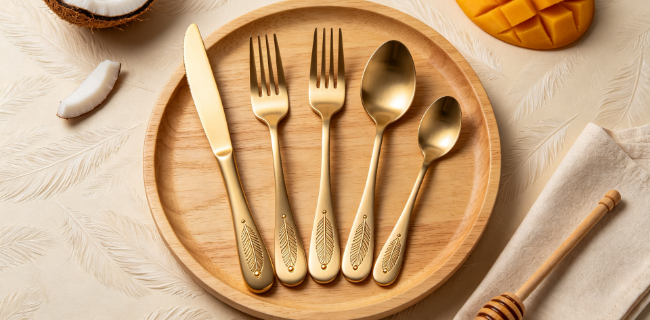
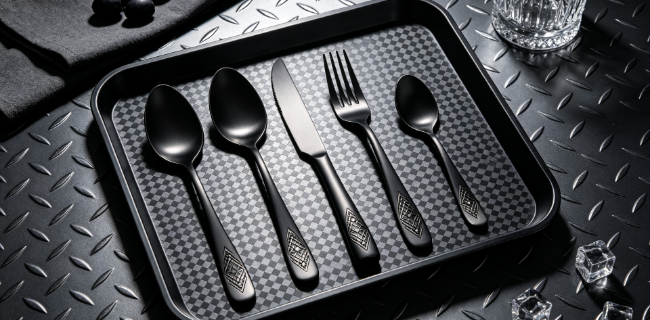
On spoons, the handle is a common location because it allows the logo to remain visible without occupying the bowl. On forks, the handle usually offers a practical marking area, although its width and curvature must be checked. For knives, the suitable position depends on the blade and handle design, as well as the intended visual effect.
The logo specification should include:
Exact position on each item.
Maximum logo width and height in millimeters.
Artwork file format and approved version.
Required orientation when the cutlery is placed on a table.
Acceptable marking appearance and inspection criteria.
These details reduce interpretation differences between sampling and mass production. They also help purchasing teams compare quotations from different manufacturers using the same requirements.
Stainless Steel Grade and Surface Finish
Material selection affects the product's performance and can influence the visual result of a marking process. Common cutlery specifications include grades such as 304 and 430 stainless steel, but the appropriate material depends on the product design, usage conditions, and buyer's requirements.
Surface finish is another important variable. Mirror-polished, satin, and other finishes reflect light differently, so the same logo may appear more noticeable on one finish than another. Buyers should not assume that a marking approved on a polished spoon will look identical on a brushed-finish fork.
For a reliable specification, record the stainless steel grade, material thickness where applicable, finish, item dimensions, and logo requirements together. This gives the factory a clearer reference for sampling and production.
Any claims about corrosion resistance, food-contact suitability, or cleaning performance should be supported by the relevant material information and applicable test documentation. A logo-marking method should also be assessed to ensure it does not create unacceptable surface defects or interfere with the product's intended use.
Sample Approval Before Bulk Production
Sample approval is a critical step in branded cutlery projects. Buyers should review the marked product itself rather than approving the logo artwork alone.
A useful approval process includes the following steps:
Submit the final vector artwork and branding instructions.
Confirm the logo position, dimensions, and orientation for each item.
Review a physical sample for readability, appearance, and consistency with the selected finish.
Confirm the approved sample or reference standard in writing.
Use the approved requirements for production inspection.
For multi-item sets, check the logo across spoons, forks, and knives. The marking should feel consistent as a collection, even though the available surface areas may differ. Any permitted variation should be defined before production begins.
Buyers should also establish how artwork revisions will be controlled. A change to the logo proportions, position, or color expectations after sample approval may affect production planning and cost.
Quality Control for Branded Cutlery Orders
Branding inspection should be included in the broader product quality plan. Relevant checkpoints may include logo presence, placement, legibility, surface appearance, and consistency against the approved sample.
For large-volume orders, a documented inspection plan can help purchasing teams and factories evaluate the same criteria. Depending on the project, checks may be performed during production and on finished goods before shipment.
The inspection record should identify the product model, approved artwork version, sample reference, inspection criteria, and any corrective action taken. Where applicable, material certificates and product testing reports can be reviewed alongside the branding inspection records.
Homefelt factory works with buyers on customized stainless steel cutlery specifications, including product design coordination and packaging requirements. The exact inspection documents and testing scope should be confirmed for each project rather than assumed to be identical across all products.
How Logo Customization Affects Order Planning
The cost of branded cutlery depends on more than the logo itself. Buyers should consider the number of product models, marking complexity, sampling requirements, order quantity, packaging format, and inspection expectations.
A quotation request is easier to evaluate when it includes the following information:
Cutlery type and quantity for each item.
Stainless steel grade and surface finish.
Logo artwork and preferred marking position.
Required sample quantity and approval timeline.
Individual packaging or retail set requirements.
Destination market and expected shipment schedule.
Providing these details early helps the supplier assess feasibility and identify missing information before the project moves into production. For repeat orders, retaining the approved artwork and product specifications can also simplify reordering.
OEM, ODM, and Private Label Support from Homefelt Factory
Homefelt factory supports B2B buyers seeking customized stainless steel knives, forks, spoons, and complete cutlery sets. Depending on the project, cooperation may cover existing product selection, design adjustments, logo application, packaging development, and shipment coordination.
OEM projects generally follow the buyer's product and branding specifications. ODM projects may involve further development of product appearance or design details. Wholesale and private label customers can discuss item combinations, brand presentation, and packaging options according to their target market and order volume.
For larger programs, buyers should confirm production capacity, minimum order quantities, sample timing, quality requirements, and delivery arrangements with the factory before placing an order. Relevant certifications and testing documentation can also be discussed according to the product and project scope.
A well-defined branding specification helps both sides move from an initial concept to a repeatable product. By confirming the logo, material, finish, sample, and inspection criteria in advance, buyers can reduce avoidable revisions and establish a clearer basis for long-term supply.
You May Be Interested In
Explore stainless steel cutlery options for OEM and private label projects.
Request customized spoon, fork, and knife specifications for your product line.
Discuss logo placement, artwork requirements, and branded packaging options.
Contact Homefelt factory to request a quotation for wholesale or bulk cutlery orders.
To help prepare a project proposal, send your required product types, estimated quantities, stainless steel specifications, logo artwork, and packaging preferences. The Homefelt team can then review the requirements and discuss suitable customization and production options for your market.