


26 May
Stainless Steel Cutlery for Restaurants: How to Choose the Right Commercial Flatware
Stainless Steel Cutlery for Restaurants:...
Stainless Steel Cutlery for Restaurants: How to Choose the Right Commercial Flatware
Restaurants depend on tableware that can support daily service while matching the concept and dining experience. Among the many components of a restaurant table setting, stainless steel cutlery plays an important role because guests interact with it throughout the meal.
From casual restaurants and cafes to hotel dining rooms, fine dining establishments and restaurant groups, the right flatware should balance appearance, handling comfort, menu requirements, operational efficiency and purchasing costs.
For restaurant owners, foodservice distributors, hospitality procurement teams and international B2B buyers, selecting commercial stainless steel cutlery requires more than choosing a particular style from a catalog.
The product specification should be connected to the restaurant's menu, seating capacity, service frequency, cleaning process, storage system and expected replacement cycle.
Start With the Restaurant Concept
The restaurant concept should influence the cutlery selection.
A casual restaurant may prioritize practical daily use.
A fine dining restaurant may focus more heavily on presentation and table proportions.
A buffet restaurant may need large quantities for rapid turnover.
A hotel restaurant may require one collection that works across several meal periods.
Before comparing products, buyers should define the intended dining environment.
Match Cutlery to the Menu
The menu is one of the most useful references when developing a cutlery program.
A restaurant serving standard main courses may need table forks, knives and spoons.
Dessert menus may require smaller forks or spoons.
Breakfast operations can require teaspoons.
Steak, seafood or specialty cuisine may introduce additional utensils.
The product range should reflect actual menu requirements rather than adding unnecessary pieces.
Build a Core Restaurant Collection
A commercial restaurant can begin with a practical core collection:
Table fork
Table knife
Table spoon
Dessert fork
Dessert spoon
Teaspoon
Specialty products can then be added according to the menu and service concept.
This approach can make purchasing and inventory management easier.
Consider Restaurant Seating Capacity
Table count and seating capacity are important when calculating initial quantities.
However, the total number of seats is only the beginning.
Purchasing teams should also consider:
Average table turnover
Number of daily meal periods
Peak service volume
Cleaning turnaround
Number of dining rooms
Banquet or event service
Reserve stock
Replacement demand
A restaurant with rapid table turnover may need substantially more active cutlery than a restaurant with slower service.
Table Turnover and Inventory
A restaurant may reuse the same cutlery several times during a busy service period.
If used products are not returned from cleaning quickly enough, the available inventory can become a bottleneck.
The purchasing quantity should therefore reflect the complete circulation cycle from table to collection, cleaning, inspection and redistribution.
Choose the Right Stainless Steel Specification
Material specification is an important part of commercial flatware purchasing.
Common stainless steel specifications can have different compositions and performance characteristics.
Buyers should identify the material requirement appropriate for their intended application and market.
The final specification should be confirmed with the manufacturer before production.
Evaluate Weight and Balance
Cutlery is part of the guest experience.
A product that feels balanced in the hand can contribute to a more comfortable dining experience.
Buyers should compare physical samples rather than selecting products solely from photographs.
Handle proportions, overall weight and balance can all be evaluated during sample approval.
Handle Design
Handle design influences both appearance and handling.
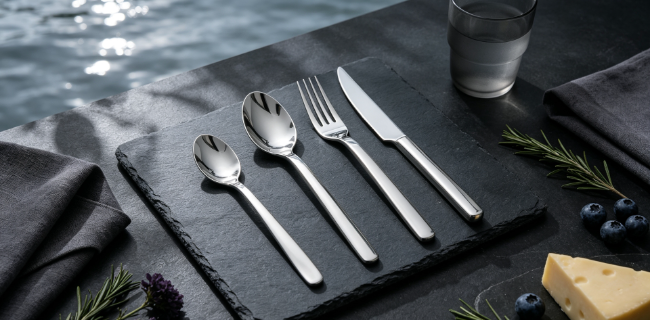
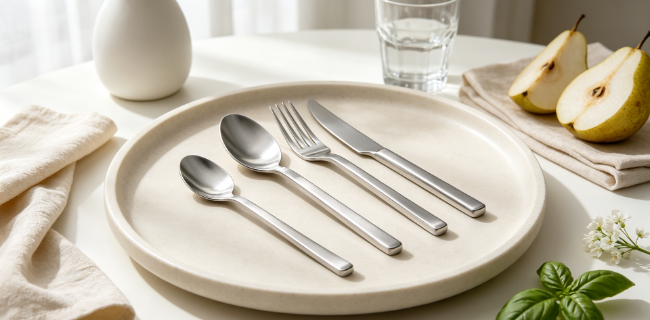
Straight handles can create a clean contemporary look.
Rounded profiles can provide a softer visual impression.
More decorative designs may suit traditional or premium restaurants.
The handle should coordinate with plates, glassware, table linens and the restaurant interior.
Surface Finish
Stainless steel cutlery is available with different surface treatments.
Polished finishes can provide a bright appearance.
Satin finishes can create a softer visual effect.
Brushed finishes may suit modern restaurant concepts.
The selected finish should be evaluated under the restaurant's actual lighting conditions when possible.
Match the Tableware
Cutlery should not be selected independently from the rest of the table setting.
Buyers should evaluate it with:
Dinner plates
Side plates
Bowls
Glassware
Serving pieces
Table linens
Trays where applicable
A coordinated collection can create a more consistent dining presentation.
Casual Restaurant Flatware
Casual restaurants often require a combination of practicality and visual appeal.
The cutlery should support frequent daily use while maintaining a consistent appearance.
A standardized core collection can simplify replenishment when individual pieces need replacement.
Fine Dining Flatware
Fine dining restaurants may require more detailed table settings.
The cutlery can become an important visual component of the table.
Product proportions, handle design, surface finish, weight and balance should be evaluated carefully.
Additional specialty pieces may be required depending on the menu.
Buffet Restaurant Cutlery
Buffet restaurants can experience high table turnover and concentrated demand.
Guests may use multiple utensils during a single visit.
A sufficient reserve quantity is important for rapid replenishment.
The products should also be easy for staff to organize at buffet stations.
Cafe and Bistro Dining
Cafes and bistros often use compact dining spaces.
The selected cutlery should fit smaller tables without creating unnecessary clutter.
A versatile collection can support breakfast, lunch, desserts and beverages while limiting the number of different product references.
Restaurant Chains
Restaurant groups may operate many locations with the same or similar concept.
Centralized purchasing can establish a standard cutlery specification across the group.
Individual restaurants can then purchase quantities based on local seating capacity and service volume.
This approach can simplify replacement and improve brand consistency.
Multi-Concept Restaurant Groups
Some hospitality groups operate several restaurant concepts.
In this case, each concept can have its own approved collection while central procurement manages the specifications.
This creates a balance between individual restaurant identity and efficient group purchasing.
Cleaning and Reuse
Reusable stainless steel cutlery can be incorporated into restaurant foodservice where the operator's established procedures support reusable tableware.
Products can move through collection, sorting, cleaning, inspection and redistribution according to the restaurant's workflow.
Restaurants should follow their applicable sanitation and foodservice procedures.
Storage and Organization
A restaurant's storage system should be considered before finalizing the cutlery collection.
Products can be separated by type and stored in locations that support efficient service preparation.
High-use products should be easy for staff to access.
Reserve stock can be kept separately to support replenishment and replacement.
Replacement Planning
Restaurant cutlery experiences continuous handling.
Individual pieces may be lost, damaged or removed from service.
A replacement plan helps preserve a consistent table setting.
Buyers should retain the original product specification and approved sample for future purchasing.
Custom Restaurant Cutlery
Restaurants may want a distinctive cutlery collection to strengthen their visual identity.
Custom stainless steel cutlery can be developed with selected handle shapes, surface finishes or other design elements.
For larger projects, buyers should request samples before approving mass production.
Approved samples can also serve as references for future repeat orders.
Private Label Restaurant Flatware
Restaurant groups and foodservice distributors may require private label products.
A manufacturer can discuss branding, packaging and product specifications according to the buyer's requirements.
Packaging can be coordinated with the restaurant group's internal distribution system.
Packaging for B2B Orders
Commercial flatware is often purchased in bulk.
Packaging should protect the products during factory handling, transportation, warehousing and final distribution.
Carton quantities can be planned around the buyer's storage and distribution requirements.
Clear product identification can also simplify receiving.
Long-Term Supply
A restaurant may use the same flatware collection for several years.
If replacement products change dimensions or finish, the dining set can become inconsistent.
Before placing the initial order, buyers should discuss repeat production and product availability with the manufacturer.
Maintaining approved samples and specifications can simplify future replenishment.
New Restaurant Opening
New restaurant projects require cutlery to be selected alongside dinnerware, glassware, furniture and interior design.
Purchasing teams can test samples during the table-setting stage.
This allows buyers to evaluate the complete visual presentation before confirming the final production order.
Restaurant Renovation
Renovating a restaurant may involve new tables, chairs, plates and other dining accessories.
Cutlery can be updated at the same time.
If the restaurant wants to maintain its existing brand identity, the previous specification can be used as a reference when developing a new collection.
Foodservice Distributor Procurement
Distributors often need products that can serve several restaurant customers.
A standardized commercial cutlery range can make inventory management easier.
Distributors can select several popular product specifications and maintain stock according to customer demand.
Manufacturers can also support customized products for larger B2B programs.
Working With an Experienced Manufacturer
Commercial restaurant projects can require large quantities, multiple product references, private labeling and repeat production.
Homefelt has more than 30 years of stainless steel manufacturing experience and produces stainless steel cutlery together with kitchen and dining products, BBQ tools, pet bowls and children's tableware.
For international B2B customers, Homefelt supports standard and customized stainless steel products.
Restaurant groups, foodservice distributors, hospitality suppliers and importers can discuss material, dimensions, handle design, finish, packaging, branding and estimated quantities according to their requirements.
For long-term projects, approved samples and detailed product specifications can also be retained for future production.
What Restaurant Buyers Should Prepare
Before requesting a quotation, buyers can prepare:
Restaurant concept
Number of locations
Seating capacity
Average daily covers
Peak service volume
Menu format
Required cutlery types
Material specification
Surface finish
Packaging requirements
Branding requirements
Estimated annual demand
This information can help the manufacturer recommend a suitable commercial cutlery configuration.
Establish a Restaurant Flatware Standard
Restaurant groups can create a written product specification for each dining concept.
The document can include material, dimensions, finish, packaging and approved samples.
Future restaurants can then use the same specification during procurement.
This can reduce variation and simplify replacement.
Prepare for Future Growth
A restaurant brand may expand from one location to multiple cities or countries.
A stable cutlery specification makes it easier to reproduce the same dining presentation at new locations.
Central purchasing teams can maintain product documentation and approved samples for future expansion.
This creates a more consistent sourcing process as the restaurant group grows.
Conclusion
Choosing stainless steel cutlery for restaurants requires a clear understanding of the restaurant concept, menu, seating capacity, service frequency and overall dining environment.
Buyers should evaluate material specification, product dimensions, weight, balance, handle design, surface finish, tableware compatibility, storage, cleaning workflow and replacement requirements.
For restaurant groups and foodservice distributors, standardized specifications can simplify procurement while allowing different concepts to maintain their own visual identity.
Homefelt has more than 30 years of stainless steel manufacturing experience and works with international wholesalers, retailers, distributors and foodservice suppliers on standard and customized stainless steel products.
By sharing the restaurant concept, expected volume, menu requirements and product preferences with the manufacturer, B2B buyers can develop a commercial stainless steel cutlery program that supports consistent dining presentation and reliable long-term supply.