

11 May
Stainless Steel Flatware Weight Specifications for OEM and Private Label Buyers
Stainless Steel Flatware Weight Specific...
Stainless Steel Flatware Weight Specifications for OEM and Private Label Buyers
Weight is an important specification when developing stainless steel cutlery for wholesale, retail, hospitality and private label programs. Although buyers often focus first on appearance, dimensions and material, the weight of a knife, fork or spoon can strongly influence the perceived quality, handling and overall configuration of a flatware set.
For OEM and ODM projects, weight should therefore be considered together with dimensions, thickness, handle construction and product design. Homefelt factory can help buyers establish practical weight specifications for individual pieces and complete stainless steel flatware sets before bulk production.
Why Flatware Weight Matters in B2B Purchasing
Two stainless steel spoons can have similar overall dimensions but different weights because of differences in thickness, handle geometry, bowl depth or manufacturing construction.
For commercial buyers, weight can influence several areas:
Product feel in the hand
Perceived quality
Packaging configuration
Total shipment weight
Retail product specifications
Set composition
Warehouse handling
Replenishment planning
A lightweight design may be suitable for certain high-volume applications, while a heavier construction may be preferred for premium tableware collections.
The correct target therefore depends on the intended market and application rather than simply choosing the heaviest possible product.
Individual Piece Weight vs. Set Weight
For a complete flatware collection, there are two useful levels of weight specification.
The first is the weight of each individual item. A buyer may specify target weights for the table knife, table fork, table spoon and teaspoon separately.
The second is the total weight of the complete set.
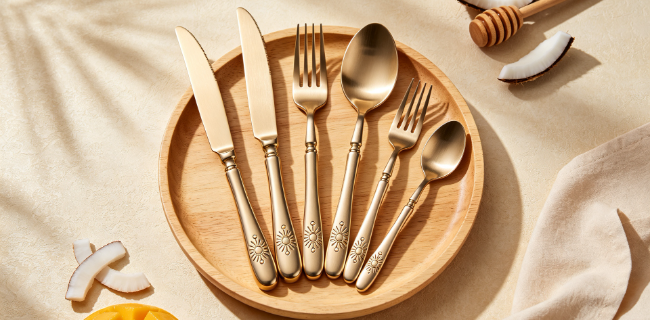
For example, if a four-piece place setting contains:
1 table knife
1 table fork
1 table spoon
1 teaspoon
the combined product weight can be reviewed alongside the individual piece weights.
For larger sets, the total weight becomes more significant because multiple pieces, inner packaging and outer cartons contribute to the final shipment weight.
How Thickness Influences Cutlery Weight
Thickness is one of the major factors affecting stainless steel flatware weight, but it is not the only one.
A thicker blank will generally contain more material. However, two products with the same nominal thickness can still have different weights because their shapes and dimensions are different.
Important variables include:
Overall product length
Maximum product width
Handle width
Handle profile
Bowl dimensions
Fork head dimensions
Blade geometry
Product thickness
Material density
Additional handle components
For this reason, a weight target should be evaluated alongside the complete product drawing rather than considered as an isolated number.
Weight and Handle Construction
The handle can account for a meaningful portion of the overall weight of a cutlery piece.
A broad handle, tapered handle or sculpted profile may require a different material distribution from a simple straight handle. If the product includes a mixed-material handle, the relationship between the stainless steel component and other materials also needs to be considered.
For OEM projects, the desired hand feel can therefore be described through both physical dimensions and target weight.
This is particularly useful when a buyer wants a collection that feels balanced across the knife, fork and spoon.
Balance Is Different from Total Weight
A heavier product is not automatically better balanced.
Balance depends on how the weight is distributed along the length of the piece. For example, changing the handle profile can shift the center of mass without dramatically changing the total product weight.
When developing a private label collection, buyers can therefore consider two separate requirements:
Overall product weight
Weight distribution and handling feel
This distinction helps explain why two flatware pieces with nearly identical weights can feel different during use.
Weight Specifications for Different Cutlery Pieces
Knives, forks and spoons have different structures, so a single weight target should not automatically be applied to every piece.
A table knife may have a longer blade and different material distribution from a table fork. A spoon has a formed bowl that affects both geometry and weight. A teaspoon is smaller and normally requires a different target.
For an OEM flatware collection, a product specification table can identify the expected range for each SKU.
A practical specification may include:
Product code
Product name
Overall length
Maximum width
Thickness
Target weight
Permitted weight variation
Material
Surface finish
Reference drawing
This provides a useful technical reference for both purchasing and manufacturing teams.
Setting a Practical Weight Tolerance
Production cannot always deliver every individual piece at exactly the same weight. Minor variations can occur because of material thickness, forming, grinding and finishing processes.
For this reason, B2B buyers should define a reasonable tolerance instead of requiring an unrealistic exact number.
The appropriate tolerance depends on the product structure and manufacturing process. A heavier piece with a more complex shape may require a different tolerance from a small teaspoon.
The important point is that the target and acceptable range should be established before mass production.
Homefelt can review the proposed weight requirement together with the product dimensions and manufacturing process to determine whether the target is practical for large-volume production.
Weight Control During OEM Production
For customized stainless steel cutlery, weight can be checked at different stages of the manufacturing process.
During product development, the factory can compare the prototype against the target specification.
During production, sample measurements can help verify that the manufactured pieces remain within the agreed range.
For final inspection, weight can be checked together with dimensions, appearance and other customer requirements.
This staged approach is more useful than discovering a significant difference only after the entire order has been completed.
Complete Set Weight and Packaging
When a flatware set is sold as one retail or wholesale unit, the product weight also interacts with the packaging configuration.
A heavier cutlery set may require consideration of:
Inner box structure
Package handling
Outer carton weight
Carton quantity
Shipping configuration
Warehouse handling
The packaging should be developed around the actual product weight rather than an assumed value.
For private label buyers, this is especially important when the finished set will be sold through retail channels or distributed in large quantities.
Weight as a Commercial Product Specification
Weight can also be part of how a buyer positions a collection.
A commercial foodservice range may prioritize practical construction and efficient handling. A premium retail collection may use a heavier profile to create a substantial hand feel. A distributor may need several weight options to serve different customer segments.
There is no universal “best” weight for stainless steel flatware.
The better approach is to match weight with:
Intended customer
Product price level
Usage frequency
Collection design
Material specification
Target market
Packaging requirements
This creates a more rational product specification than selecting weight based only on appearance.
Homefelt Experience with Weight-Based Product Development
Homefelt factory has more than 40 years of experience in the stainless steel cutlery business. The factory supports OEM, ODM, private label, wholesale and large-volume production for different types of buyers.
In practical projects, weight requirements can vary significantly. Some customers want a lighter collection for high-volume commercial use, while others want a more substantial feel for premium retail positioning.
The Homefelt team can review product drawings, dimensions, material specifications and target weights together so that the final requirement remains suitable for actual manufacturing.
Material and Factory Documentation
Weight should always be evaluated together with the agreed stainless steel specification and product construction.
For international B2B projects, customers may also request factory qualification documents, inspection information and relevant certification materials. Homefelt has passed BSCI, SEDEX 4P, BRC and ISO9001-related requirements, with Disney audit experience and FAMA and FSC certifications.
These documents can support supplier evaluation, while the product specification and inspection reference remain the primary basis for the actual cutlery order.
OEM and Private Label Weight Customization
For customers developing their own stainless steel flatware collection, Homefelt can support different levels of customization.
The project may begin with an existing Homefelt design and a target weight adjustment, or the buyer may provide a completely new product concept.
Customization can cover:
Knife weight
Fork weight
Spoon weight
Teaspoon weight
Set weight
Handle dimensions
Product thickness
Surface finish
Logo requirements
Packaging configuration
The objective is to create a product that matches the buyer's desired quality level while remaining practical for bulk manufacturing.
One-Stop Support for Complete Cutlery Programs
Weight is only one part of a successful B2B flatware project. Buyers may also need assistance with product development, material selection, surface finishing, packaging and transportation.
Homefelt provides one-stop service according to the customer's actual requirements. Product design, stainless steel knife-fork-spoon manufacturing, packaging coordination and transportation can be organized as one project.
This allows distributors, retailers, hospitality suppliers and private label brands to work with one experienced manufacturing partner rather than coordinating every stage separately.
Choosing the Right Weight Specification
When preparing an OEM stainless steel cutlery project, buyers can provide a target weight together with product drawings, dimensions and intended application.
If the exact weight has not yet been determined, the factory can review the product structure and recommend a practical range for discussion.
A useful starting specification includes:
Product type
Overall dimensions
Material
Thickness
Target weight
Acceptable tolerance
Surface finish
Intended application
Expected order quantity
This information gives the manufacturer a clear basis for developing samples and preparing a bulk production quotation.
For buyers looking for a long-term stainless steel cutlery partner, the goal is not simply to manufacture products to a number. It is to create a consistent product specification that can be reproduced reliably across future orders.
Homefelt factory combines stainless steel cutlery manufacturing experience with OEM, ODM, private label and wholesale capabilities. Customers can customize an exclusive service package according to their product requirements, market positioning and purchasing volume.
You May Be Interested In
If you are developing a custom stainless steel spoon, fork, table knife or complete flatware set and need a specific weight, thickness or product configuration, send your requirements to ingrid@homefelt.net.
Homefelt can review your specifications and support product development, bulk manufacturing, packaging and transportation as a one-stop service for your stainless steel cutlery project.