

17 May
Stainless Steel Dessert Spoons: Product Selection for Wholesale Buyers
Stainless Steel Dessert Spoons: Product ...
Stainless Steel Dessert Spoons: Product Selection for Wholesale Buyers
Dessert spoons may be smaller than standard table spoons, but their proportions can make a noticeable difference to the dining experience. For importers, distributors, retailers and hospitality suppliers, selecting the right stainless steel dessert spoon involves more than choosing an attractive design. Bowl dimensions, handle length, overall balance and coordination with other cutlery items all influence the suitability of a product for its target market.
Homefelt factory works with B2B customers seeking stainless steel cutlery customization, OEM/ODM production and wholesale supply. By defining the intended application and product specifications early, buyers can develop dessert spoons that fit a collection, meet customer expectations and support repeat orders.
1. Understanding the Role of a Dessert Spoon
A dessert spoon is commonly used for puddings, cakes served with sauces, fruit desserts and other dishes that require a spoon rather than a fork alone. Its design usually needs to balance a comfortable grip with a bowl that can handle the intended food.
However, there is no single dimension that suits every dessert spoon project. Some buyers prefer a compact spoon for coordinated tableware collections, while others need a larger profile for hospitality use or a more distinctive design for retail flatware ranges.
Before requesting samples, buyers should identify the primary application:
Retail cutlery collections for household use
Coordinated flatware sets for hospitality customers
Dessert-service products for catering suppliers
Custom-designed collections for private-label brands
Wholesale cutlery assortments for regional distributors
The intended market provides a useful starting point for selecting dimensions, appearance and order configuration.
2. Bowl Proportions and Product Function
The bowl is one of the most recognizable features of a dessert spoon. Its width, length, depth and curvature affect both its appearance and how it performs during use.
A relatively narrow bowl may create a refined, elongated appearance, while a wider bowl can provide a different visual proportion and a more generous spooning surface. Bowl depth should also be considered in relation to the food being served.
When reviewing a proposed design, purchasing teams can assess the following points:
| Design Element | Selection Consideration |
|---|---|
| Bowl length | Should be proportionate to the overall spoon length |
| Bowl width | Influences appearance and the available spooning surface |
| Bowl depth | Should suit the intended dessert and serving style |
| Bowl curvature | Affects the shape and visual character of the product |
| Handle-to-bowl ratio | Helps determine whether the complete design looks balanced |
These characteristics should be evaluated together rather than independently. A wider bowl paired with a very short handle, for example, creates a different overall impression from a narrow bowl with an elongated handle.
For OEM projects, buyers can provide a drawing or reference sample. For ODM projects, the factory and customer can discuss alternative proportions before confirming the final design.
3. Handle Design and Overall Appearance
The handle helps establish the identity of a dessert spoon. Straight handles often create a clean, contemporary look, while tapered, rounded or decorative profiles can give a collection a different character.
For coordinated cutlery, the dessert spoon should relate visually to the matching dinner spoon, fork and knife. The items do not necessarily need identical dimensions, but their handle profiles, surface treatments and design details should feel consistent.
Buyers should consider:
Whether the handle matches the existing cutlery collection
Whether its width and profile feel comfortable in the hand
Whether decorative details can be reproduced consistently
Whether the design is suitable for the target retail or hospitality market
Whether the proposed shape can be manufactured to the agreed specification
A consistent design language helps distributors present a coherent collection instead of a group of unrelated products.
4. Choosing Stainless Steel and Surface Finishes
Material selection influences the product's appearance, durability and positioning. Stainless steel grades should be confirmed according to the buyer's requirements, intended market and available product documentation.
The proposed grade, thickness, weight and construction should be stated clearly in the product specification. Buyers should avoid relying on descriptions such as “premium stainless steel” without requesting the actual material details.
Surface finish also changes the character of a dessert spoon. Mirror polishing creates a bright, reflective appearance, while a brushed or satin finish produces a more subdued visual effect. Other decorative treatments may be considered for suitable designs, subject to manufacturing feasibility and the customer's requirements.
When comparing samples, buyers should check the finish under consistent lighting and examine whether the bowl and handle have a uniform appearance. Any special finish should be documented in the approved sample or specification sheet so that repeat orders have a clear reference.
5. Developing a Dessert Spoon Collection for Wholesale
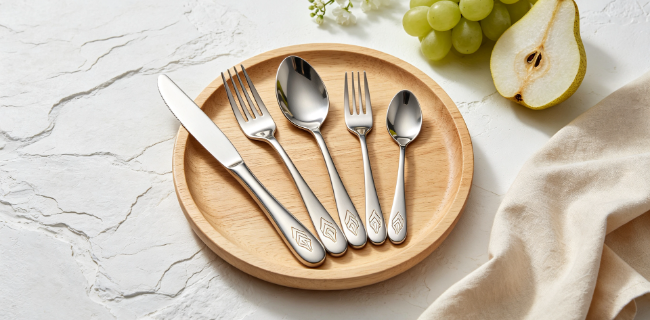
Wholesale buyers often need more than one individual spoon. They may require a coordinated assortment that includes dessert spoons, teaspoons, dinner spoons, forks and knives.
A well-planned assortment begins with the target customer and expected sales channels. A retailer may prioritize visual consistency and packaging presentation, while a distributor may focus on product availability, assortment flexibility and repeat-order requirements.
Before placing a bulk order, establish a product schedule that includes:
Product names and item codes
Approved dimensions and material grades
Surface finish and handle design
Quantities for each item
Packaging configuration and branding requirements
Sample approval and inspection criteria
For private-label projects, the buyer should also provide the brand artwork, logo specifications and packaging information early enough for the relevant details to be reviewed before production.
Homefelt factory supports OEM/ODM customization and wholesale stainless steel cutlery projects. Customers can discuss product design, coordinated collections, packaging and transportation requirements as part of a one-stop service process.
6. Quality Documentation and Supplier Coordination
A product specification is more useful when it is supported by clear approval and inspection procedures. Before mass production, buyers should confirm the reference sample, dimensions, finish, material requirements and acceptable appearance criteria.
Depending on the project, relevant documentation may include material information, product inspection records, applicable test reports and company audit documents. Homefelt has experience with audit and certification programs including BSCI, SEDEX 4P and ISO 9001. Buyers should confirm which documents are applicable and available for their particular order rather than assuming that every certification applies to every product.
Clear communication is especially important when a dessert spoon forms part of a larger collection. If the buyer changes the handle profile, material grade or finish after sample approval, the updated requirements should be recorded and reviewed before production proceeds.
7. Requesting a Quote from Homefelt Factory
To receive a useful quotation, B2B buyers can share the target dessert spoon design, estimated quantity, material preference, finish, branding needs and packaging requirements. Drawings, product images or physical reference samples can help clarify the expected result.
If the specifications are not yet complete, buyers can begin with their target market, preferred style and approximate order volume. The next step is to discuss feasible designs, confirm the main technical details and establish a sample approval process.
Homefelt factory welcomes inquiries from importers, distributors, retailers and brands looking for stainless steel dessert spoons, customized flatware and bulk manufacturing support. The aim is to develop a product solution that fits the customer's requirements and supports a reliable long-term supply relationship.
You May Be Interested In
Stainless Steel Spoon Bowl Depth and Shape: A Guide for B2B Buyers
Stainless Steel Spoon Surface Finish: Comparing Mirror Polish and Satin Styles
Stainless Steel Spoon Dimensions: A Practical Specification Guide for B2B Buyers